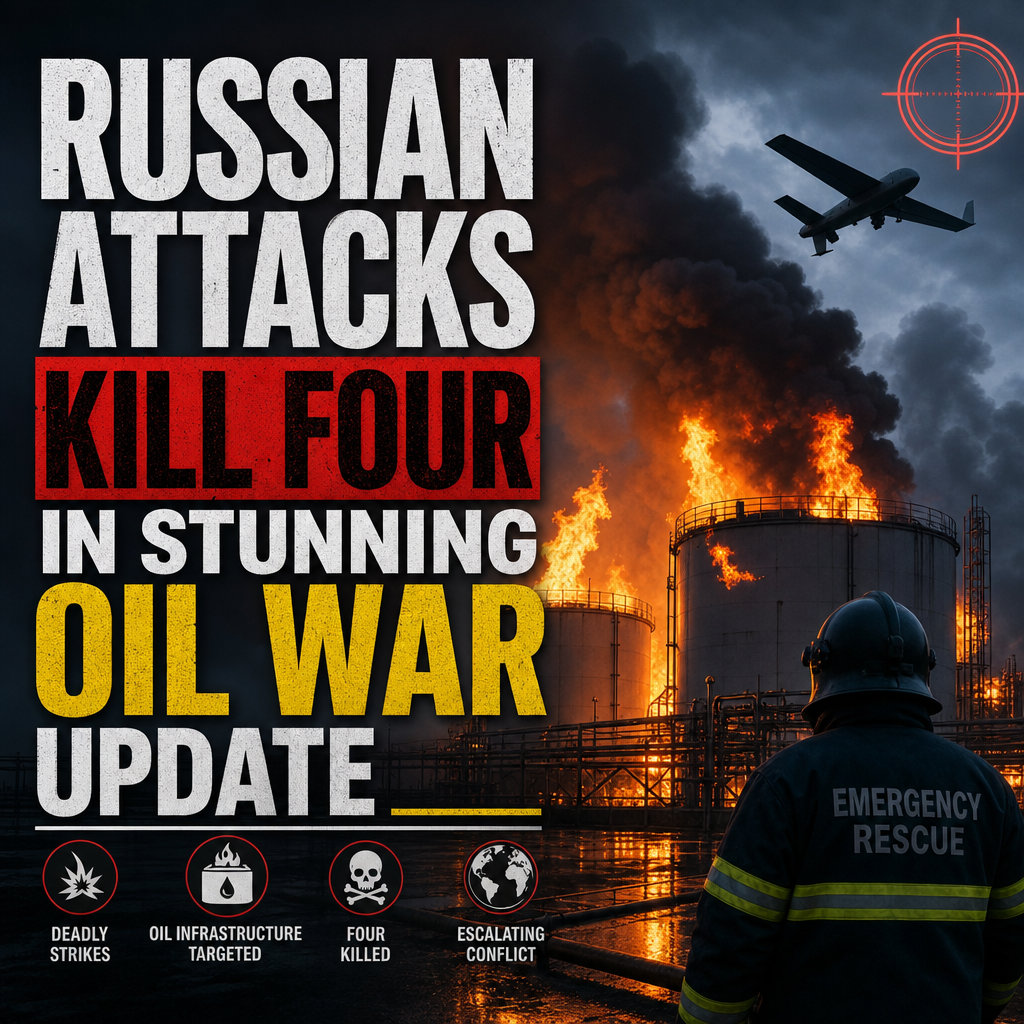
Russian Attacks Kill Four in Stunning Oil War Update


Russian attacks have once again turned a fast-moving war into a story about both battlefield violence and economic pressure, with new strikes killing four people in Ukraine as Kyiv keeps up its campaign against Russian oil infrastructure.
The latest developments underline a painful reality: this war is no longer only being fought with shells and drones on the front line. It is also being fought through energy systems, fuel supplies, and long-range strikes aimed at weakening the other side’s capacity to keep going. Different news outlets frame that struggle in slightly different ways, but the broad picture is consistent — escalation is continuing, civilians remain at risk, and neither side appears willing to ease off.



Russian attacks and the widening energy war
The most immediate human cost remains in Ukraine, where Russian strikes reportedly killed four people. That toll matters not just as a statistic, but because it reflects how vulnerable towns and cities remain even as the war enters yet another phase of attritional violence. In many conflict reports, the details of the weaponry matter, but the effect is the same: homes, infrastructure, and ordinary routines are repeatedly disrupted.
At the same time, Ukraine’s attacks on oil-related targets inside Russia are becoming an increasingly important part of the story. These strikes are often presented by Kyiv’s supporters as a legitimate way to disrupt the machinery of war. Fuel is essential not only for transport and industry but also for military logistics, so targeting oil infrastructure is seen by Ukrainian officials as a way to raise the cost of Russia’s invasion.




That logic is not universally accepted, of course. Russian state-aligned coverage typically portrays such strikes as reckless escalation, insisting that they threaten civilians, damage critical infrastructure, and prove that Ukraine is broadening the war. From that perspective, the attacks are not strategic pressure; they are an attempt to impose pain on the Russian economy and population.
Both views contain part of the truth. Oil infrastructure is undeniably strategic, which is exactly why it has become a target. But it is also hazardous to attack, because facilities linked to fuel production and storage can trigger large fires, secondary explosions, and environmental damage far beyond the immediate strike zone. That makes this phase of the war especially unstable.
What the reporting agrees on
Across the different feeds, a few points stand out:
– Russian attacks continue to kill and injure civilians in Ukraine.
– Ukraine is maintaining pressure on Russian oil and energy infrastructure.
– The conflict is increasingly defined by long-range strikes rather than only trench warfare.
– Both sides frame their actions as necessary, defensive, or retaliatory.
– Civilian risk remains high, especially when energy facilities are hit.
This is where the coverage from outlets like Al Jazeera and Sky News is especially useful. Their reporting tends to place the strikes within a broader war context, emphasizing the civilian toll while also noting the strategic logic behind attacking energy assets. That approach makes the conflict easier to understand than coverage that focuses only on military claims or official statements.
Ukraine’s oil strategy: pressure, symbolism, and risk
Ukraine’s campaign against Russian oil infrastructure serves several purposes at once. First, it aims to disrupt the flow of fuel that supports military operations. Second, it sends a message that Russia’s rear areas are no longer safe. Third, it creates economic pressure on a sector that is central to Russia’s state revenues.
But the strategy comes with trade-offs. Even when the targets are military-adjacent or economically important, the optics are complicated. Critics argue that striking energy infrastructure can deepen the war’s humanitarian and environmental costs. Supporters counter that Ukraine is facing a far larger military power and is using one of the few available ways to shift the balance.
There is also a political dimension. These attacks are not happening in a vacuum; they are being interpreted by domestic audiences, allies, and neutral states watching for signs of escalation. For Ukraine, demonstrating reach can be important for morale and deterrence. For Russia, any successful strike on oil infrastructure can be used to argue that the war is harming its own citizens and economy, strengthening the case for harsher retaliation.
That dynamic creates a familiar cycle: each side says it is responding to the other’s aggression, while the battlefield grows wider and less predictable.
Why the tone of coverage matters
RT’s framing is likely to emphasize the cost of Ukrainian strikes and portray Russia as responding to threats near or inside its own territory. Al Jazeera’s reporting usually tries to balance battlefield developments with the humanitarian consequences, which is especially important in a war where official claims are often contested. Sky News, meanwhile, tends to focus on the broader geopolitical implications and the human impact of major strikes.
Taken together, those perspectives help prevent a one-sided reading. The war is not simply a contest of firepower; it is also a contest of narratives. Each outlet highlights different evidence and uses different language, but the underlying reality remains hard to dispute: civilian deaths continue, infrastructure is under pressure, and economic targets have become part of the military equation.
A grim but clear trend
The most responsible conclusion is that this is not a sudden turning point so much as a deepening pattern. Russia’s attacks continue to inflict deadly harm in Ukraine, while Ukraine’s strikes on oil infrastructure show that it is trying to widen the cost of war for Moscow. Neither side appears close to backing down, and each new exchange makes a negotiated pause harder to imagine.
What makes this phase especially worrying is the blend of military and civilian vulnerability. Oil sites are strategic, but they can be dangerous and difficult to contain when hit. Cities remain exposed to drone and missile strikes. And as the war expands into energy systems, the consequences spread well beyond the immediate front.
For now, the clearest takeaway is also the bleakest: the conflict is becoming more dangerous, more economically disruptive, and no less deadly for the people caught underneath it.